
Editorial quality
The AI Fact-Checking Playbook for Content Teams
A practical workflow for checking AI-generated articles, video scripts, captions, and social posts before they reach your audience.
By MillsGuild Editorial · · Updated
The AI Fact-Checking Playbook for Content Teams
AI-generated content can look publication-ready while still containing an invented source, an outdated number, or a conclusion the original research does not support. Smooth writing makes these errors harder to notice, especially when a team is working quickly.
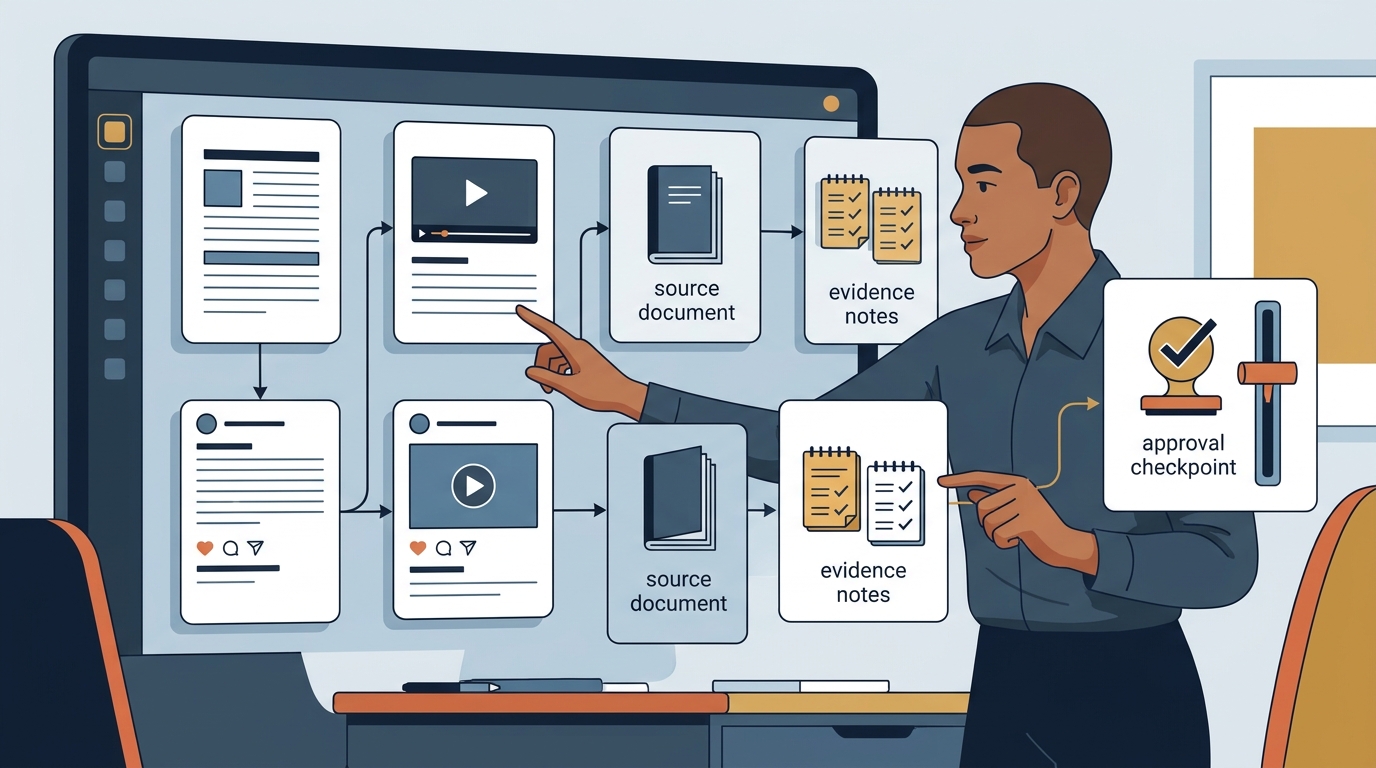
The risk increases when one draft becomes several assets. A claim can move from a research note into a video script, appear as on-screen text, get copied into a caption, and then spread across several social channels. One weak claim has become five published errors.
Place verification inside the content workflow. Teams can use AI for research support, drafting, and repurposing while keeping factual decisions with a human reviewer.
This playbook shows lean content teams how to do that without turning every post into a week-long research project.
What AI fact-checking should mean for a content team
AI fact-checking is the process of identifying verifiable claims in AI-assisted content, checking those claims against appropriate sources, recording the evidence, and requiring human approval before publication.
It is different from two related activities:
- AI detection estimates whether a person or a model produced a piece of text.
- Provenance verification examines where a file came from and how it may have been edited.
- Fact-checking asks whether a specific claim is adequately supported.
These processes can complement one another, but they answer different questions. A human-written post can be false. An AI-assisted post can be accurate. A file with valid provenance metadata can still depict or describe something untrue.
The Coalition for Content Provenance and Authenticity makes this distinction especially important. Its C2PA standard can attach cryptographically verifiable provenance information to media. That information can help establish origin and editing history, but it does not determine whether the content itself is factual.
For most marketing teams, the useful goal is to ensure that every material claim is supported, current, relevant, and represented honestly.
Start by defining what needs verification
Trying to verify every sentence with equal effort wastes time. Begin by separating factual claims from opinions, creative language, instructions, and low-risk descriptions.
A factual claim is something a reader could reasonably challenge with evidence. Common examples include:
- Statistics and percentages
- Dates and timelines
- Product features or limitations
- Prices, plan details, and availability
- Laws, regulations, and platform policies
- Scientific, medical, financial, or legal statements
- Quotes and attributed opinions
- Claims about a competitor
- Superlatives such as “largest,” “fastest,” or “most popular”
- Statements about what an image or video shows
A sentence such as “Short videos can be easier to repurpose than webinars” is broad editorial guidance. A sentence such as “Short videos generate 40 percent more conversions” is a measurable claim that needs a real source, a defined comparison, and enough context to interpret the number.
Make that distinction before polishing. Otherwise, a team may spend time perfecting a passage that later has to be removed.
Use a risk-based review system
Not every claim deserves the same review depth. A simple risk system helps small teams direct attention where an error would do the most damage.
| Risk level | Typical claims | Required review |
|---|---|---|
| Low | General workflow advice, clearly labeled opinions, creative transitions | Editorial review for clarity and usefulness |
| Medium | Product capabilities, market observations, historical details, platform behavior | Confirm with a reliable current source |
| High | Statistics, legal rules, financial guidance, health claims, direct quotations, allegations, competitor comparisons | Check the original or authoritative source, record the evidence, and require named human approval |
Risk also depends on distribution. A claim in an internal outline is easier to correct than the same claim rendered into a video, scheduled across four networks, and included in an email campaign.
Treat heavily repurposed content as higher risk because one correction may require changes in several places.
The eight-step AI content verification workflow
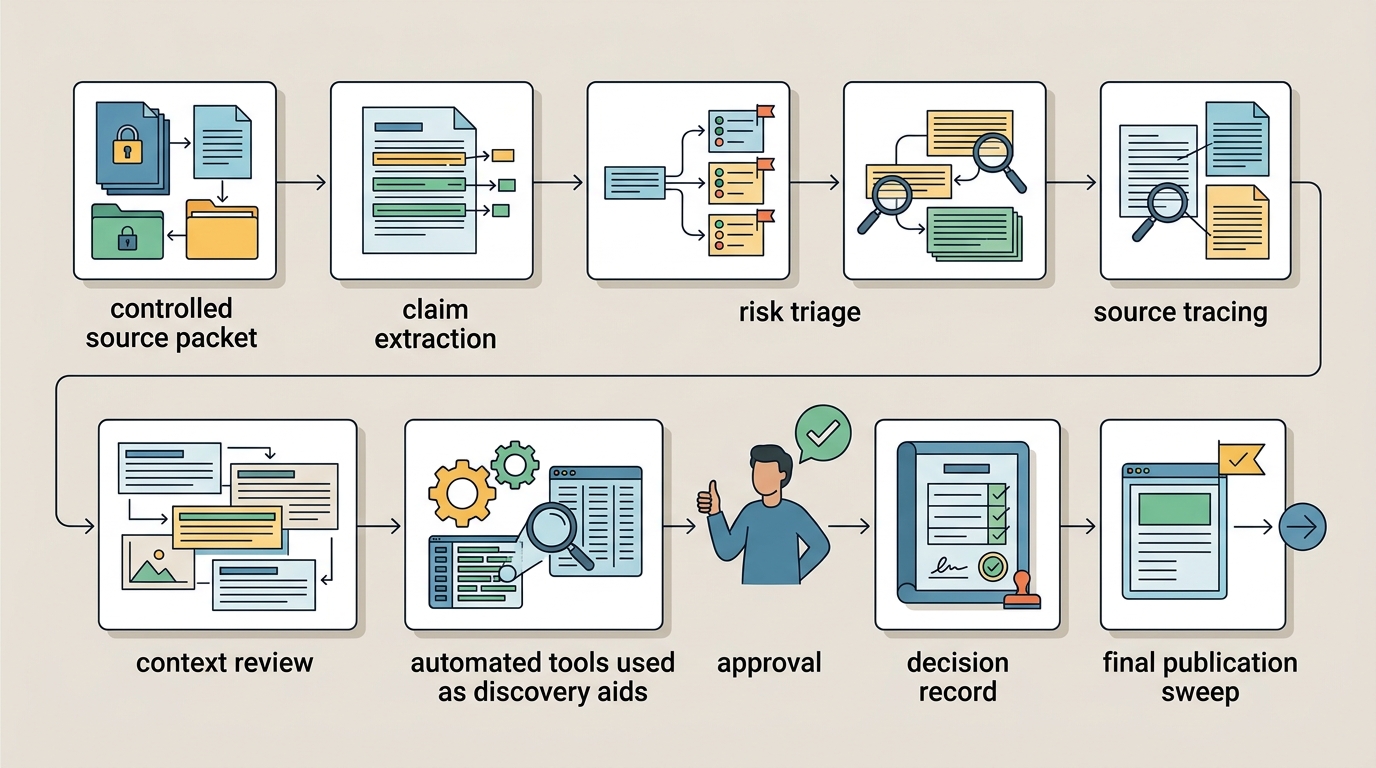
1. Give the model a controlled source packet
Verification starts before drafting. Provide the AI system with the sources you want it to use rather than asking it to rely on unspecified background knowledge.
A source packet can contain:
- Official documentation
- Original studies
- Regulatory or government pages
- Approved company information
- Interview transcripts
- Product documentation
- Current pricing or policy pages
Record when each source was accessed. Pages about pricing, product features, and social platform policies can change, so the access date matters.
Your prompt should also establish boundaries. For example:
Draft the article using only the supplied sources for factual claims. If a claim is not supported, mark it [SOURCE NEEDED]. Do not invent quotations, statistics, examples, dates, or URLs.
This will not guarantee accuracy. It does make unsupported material easier to spot.
2. Extract the claims before editing the prose
Ask the model to turn the draft into a claim ledger. The output should identify each checkable statement without trying to defend it.
A useful ledger includes:
| ID | Claim | Risk | Proposed source | Status | Reviewer note |
|---|---|---|---|---|---|
| C-01 | Exact wording of the claim | High | Original report | Pending | Check methodology and date |
| C-02 | Product supports a named feature | Medium | Official documentation | Verified | Confirmed on access date |
A ledger strips away the writing style and exposes what the article is asking readers to believe.
3. Triage the ledger
Review the claim list and assign each item a risk level. Check high-risk claims first.
Remove claims that do not contribute enough value to justify the verification effort. A decorative statistic often adds less to an article than a concrete explanation or example.
Removing low-value claims keeps fact-checking manageable. The best-supported article is not necessarily the one with the most numbers. It is the one where every important number has a clear purpose and a credible source.
4. Trace each important claim to the strongest available source
Use a source hierarchy instead of accepting the first page that repeats the claim.
A practical order is:
- Original research, official records, laws, standards, or first-party documentation
- Reputable reporting that links to or accurately explains the original material
- Specialist analysis with a transparent method and named author
- Aggregators, vendor summaries, community posts, and social content
Lower-tier sources can help you discover a claim. They usually should not be the final authority for a high-risk statement.
If ten blogs cite the same percentage but none links to the underlying study, repetition has not verified the number. It has only shown that the number was copied widely.
5. Read beyond the headline
Opening a source is not the same as verifying a claim. Check whether the source actually supports the wording in your draft.
Ask:
- Is this the original source?
- When was it published or updated?
- What population, market, or time period does it cover?
- Does the source report correlation or causation?
- Is the statistic global, regional, or platform-specific?
- Is the draft omitting an important limitation?
- Is the source making a measured finding or promoting its own product?
Suppose a study examined 500 enterprise marketers in the United States. The draft should not turn that into “most small businesses worldwide.” The number may be real while the interpretation is still wrong.
6. Use automated tools as discovery aids
Automated checkers can help locate prior reporting, surface risky sentences, or compare a claim with available sources. They should not be the final approver.
Google Fact Check Explorer is useful for finding fact checks that participating publishers have already produced. Its practical limitation is scope: a new or obscure marketing claim may never have been checked before.
Some commercial verification tools also search scholarly or web sources. For example, Factiverse describes a system that helps users identify claims and search for supporting evidence. Such tools can accelerate research, but their outputs still need human review for context, source quality, and interpretation.
Do not ask a second AI system, “Is this article accurate?” and treat a confident yes as verification. A better use is to ask it to extract claims, identify missing evidence, suggest search terms, or compare wording with a source you already selected.
7. Record the decision, not just the link
A URL by itself does not explain what was checked. Add a short verification note stating:
- Which part of the source supports the claim
- Whether the draft wording was narrowed or qualified
- The publication or update date, when available
- The date your team accessed the source
- Who approved the claim
This creates a lightweight audit trail. It also makes future updates much faster because the next editor can see why a source was accepted.
Use clear statuses such as:
- Verified
- Verified with qualification
- Unsupported
- Outdated
- Conflicting evidence
- Removed
“Verified with qualification” is particularly useful. Many claims are neither wholly right nor wholly wrong. They become accurate once the audience, time period, or limitation is stated.
8. Run a final publication sweep
Fact-checking can be undone during editing. A shortened headline may overstate a careful paragraph, or a social caption may strip away the caveat that made a statistic accurate.
Before publication, review every surface where claims appear:
- Article title and body
- Meta title and description
- Video narration
- On-screen text
- Captions and subtitles
- Thumbnail text
- Social captions
- Alt text
- Charts and graphics
- Scheduled variations of the post
The final reviewer should inspect the actual publication assets, not only the source document.
A verification checklist for AI video and social content
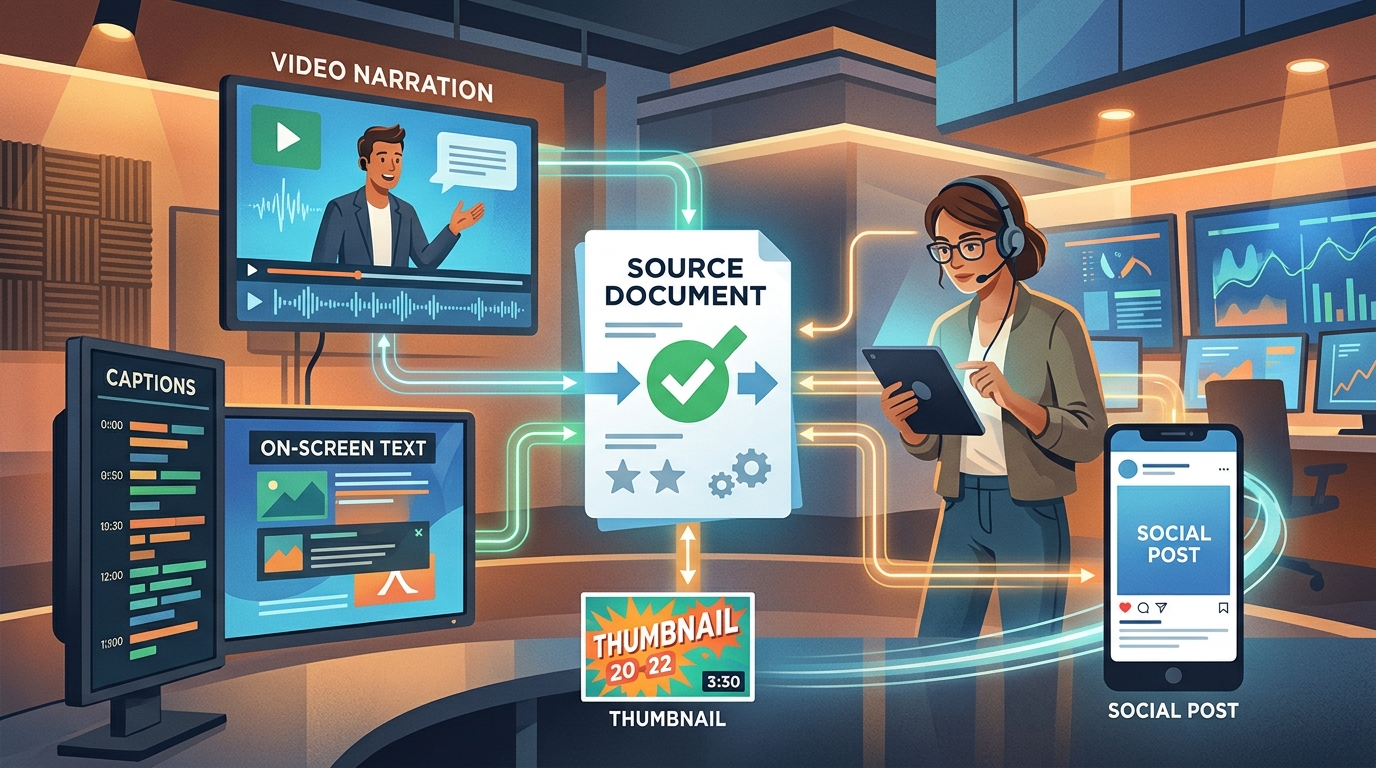
Video introduces risks that do not appear in plain text. Visuals can imply facts even when the narration is careful.
Check the script
Verify names, dates, quotations, statistics, product claims, and descriptions of events. Read the script aloud after corrections so qualifications do not become awkward or disappear during recording.
Check on-screen text separately
Editors often shorten text to fit the frame. That can turn “up to 30 percent in one vendor's study” into “30 percent better.” Compare every data card, title card, and lower third with the approved claim ledger.
Inspect generated or stock visuals
Ask whether the image could be mistaken for documentary evidence. A realistic generated image of a real event, location, person, or product may create an unsupported implication even if the spoken words are accurate.
If provenance information is available, preserve it where your production and publishing process allows. Remember that provenance records origin and edits, not truthfulness.
Match captions to the final cut
Captions created from an older script may preserve a claim that was removed from the narration. Generate or correct captions after the video is locked.
Review every channel variation
A LinkedIn post, YouTube description, Instagram caption, and short-form video overlay may all express the same idea differently. Do not assume that approval of the long-form source automatically covers every derivative asset.
Prompt templates that support verification
Prompts are most useful when they produce structured work for a reviewer rather than a vague accuracy score.
Claim extraction prompt
Extract every externally verifiable claim from this draft. Include statistics, dates, quotations, product capabilities, policy statements, comparisons, and claims about people or organizations. Return a table with the exact claim, its location, risk level, current citation if present, and verification status. Do not verify the claims yet.
Source comparison prompt
Compare the draft claim with the supplied source. Quote the exact source passage that appears to support or contradict it. Identify differences in scope, date, audience, geography, methodology, and certainty. If the source is insufficient, say so.
Unsupported claim prompt
Review this draft using only the attached source packet. Mark any factual statement that is not directly supported. Do not use outside knowledge to fill gaps. Suggest a narrower version of each unsupported claim or recommend removing it.
Repurposing prompt
Convert this approved article into a 60-second video script. Preserve all qualifications attached to factual claims. Do not introduce new numbers, examples, comparisons, or product claims. Mark any sentence that requires a new source.
These prompts reduce risk, but they do not replace the named reviewer responsible for publication.
Assign ownership so the process does not disappear under deadline pressure
A verification policy needs clear roles even when the entire content team consists of two people.
A workable division is:
- Creator: Produces the draft and supplies the initial source packet.
- Verifier: Checks material claims and updates the ledger.
- Publisher: Confirms that the approved wording appears in the final assets.
One person can hold more than one role, but high-risk content benefits from a second set of eyes. At minimum, the person approving a sensitive claim should know that they are the approver.
Set a correction procedure too. Record what changed, update derivative assets where practical, and note recurring error patterns. If invented statistics keep appearing during ideation, adjust the drafting prompt and source requirements rather than treating each incident as unrelated.
Measure whether the workflow is working
Avoid measuring only how much content AI helps produce. Volume says little about reliability.
More useful operational measures include:
- Percentage of material claims with an approved source
- Unsupported claims found before publication
- Corrections required after publication
- Average review time by risk level
- Percentage of sources past an established freshness threshold
- Repeated error types, such as fake quotations or outdated features
- Derivative assets updated after a source article changes
Measure where risk enters the workflow and spend review time accordingly.
What to look for in an AI content platform
An integrated system can reduce copying between research, drafting, editing, and publishing tools. Consolidation only helps, however, if the workflow preserves human control.
When evaluating an AI content or social automation platform, ask:
- Can users attach or reference approved sources?
- Does the system distinguish sourced material from model-generated suggestions?
- Can a team require review before publishing?
- Are drafts, video scripts, captions, and social variations editable?
- Can reviewers see what changed?
- Does the publishing workflow preserve approved wording?
- Can the team update connected assets when a claim changes?
- Does the product promise assistance or imply unsupported autonomy?
MG Social Studio supports content creation and publishing workflows in one workspace, which can keep review close to execution.
The platform does not remove the need for verification. No responsible content system should make that promise.
A lightweight policy you can adopt this week
If a full claim ledger feels too heavy, start with five rules:
- No statistic, quotation, policy statement, or competitor claim is published without a source.
- High-risk claims must point to the original or authoritative source whenever available.
- Every AI-assisted draft receives a named human reviewer.
- Repurposed assets may not introduce new factual claims without review.
- Final approval happens after captions, overlays, metadata, and social variations are complete.
That policy is short enough to use and specific enough to change behavior. Once it becomes routine, add source freshness rules, correction tracking, and review metrics.
Frequently asked questions
Can AI fact-check its own writing?
AI can help extract claims, locate possible evidence, and compare a draft with supplied sources. It should not approve its own work. A human reviewer still needs to evaluate the source, context, wording, and publication risk.
Is Google Fact Check Explorer enough for content verification?
No. It can help locate existing fact checks, but many product, marketing, and niche industry claims have not been checked by participating publishers. Use it as one research path rather than a universal verification system.
Does C2PA prove that a video is true?
No. C2PA provides a standard for recording and verifying content provenance. It can help show where media came from and how it was edited, but it does not determine whether the depicted event or accompanying claim is factual.
Should every sentence have a citation?
Not necessarily. Citations should support material factual claims. Opinions, transitions, and clearly labeled recommendations usually do not need external evidence. High-risk statements deserve the strongest sourcing and most visible qualification.
How often should published AI-assisted content be reviewed?
Set review frequency according to how quickly the subject changes. Pricing, product features, regulations, and platform policies need more frequent checks than stable historical material. Also review an asset when its source changes or when you repurpose it for a new channel.
What should a team do when reliable sources conflict?
Do not force a false conclusion. Describe the disagreement, compare the methods or definitions, and narrow the claim. If the conflict cannot be explained responsibly, remove the claim or label the uncertainty clearly.
Build verification into creation
A workable review system begins with approved sources, turns drafts into claim lists, assigns decisions to people, and checks the final assets after repurposing. The process gives editors a record of what was reviewed without asking them to research every sentence from scratch.
That approach takes more care than one-click publishing, but it is easier to manage than correcting an article, re-editing a video, replacing social posts, and rebuilding audience trust after an avoidable error.
Start creating with MG Social Studio and keep human review connected to your content workflow.
Results vary. AI-generated recommendations and content should be reviewed before publishing.