
AI content governance
Autonomous AI Content Agents vs. Approval-First Workflows: Which Is Better for Marketing?
Autonomous AI agents promise hands-off content production, but approval-first workflows give businesses more control over accuracy, brand voice, and publishing decisions. This guide explains the tradeoffs and shows where each model fits.
By MillsGuild Editorial · · Updated
Autonomous AI Content Agents vs. Approval-First Workflows: Which Is Better for Marketing?
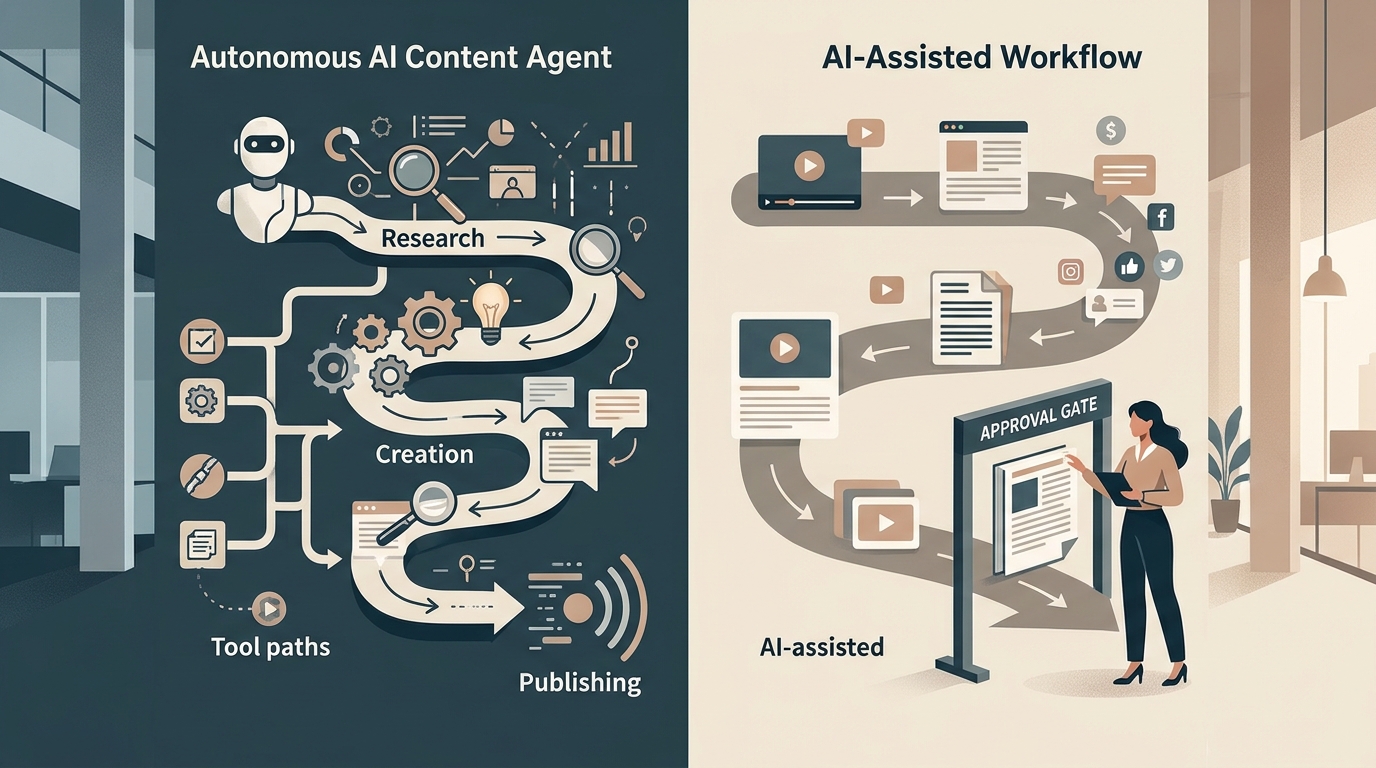
An autonomous AI content agent can research a topic, generate an asset, choose a publishing action, and continue working with little or no human intervention. An approval-first workflow uses AI for much of the same preparation but stops before consequential actions, such as publishing a video or replying to a customer, until a person approves them.
For many small businesses, creators, and lean marketing teams, approval-first is a sensible default for public content. That is editorial guidance based on the importance of brand context and accountability, not a claim that research proves one workflow is universally better. Full autonomy is more useful for low-risk, reversible work behind the scenes.
The practical goal is to automate routine production while preserving human control over claims, brand decisions, customer interactions, and anything difficult to undo.
What separates an AI agent from a standard workflow?
A conventional automated workflow follows a path designed in advance. For example:
- Take a topic from a spreadsheet.
- Generate a video script.
- Create captions.
- Place the draft in a content calendar.
- Notify an editor.
An AI model may complete several steps, but the overall path remains fixed.
An agentic system receives a goal and has more freedom to decide what to do next. It may select tools, evaluate an intermediate result, revise its plan, and repeat steps until it determines that the task is complete.
Agency and autonomy are not exactly the same thing. An agent can plan dynamically while still requiring approval before it acts. Conversely, a simple fixed workflow can be configured to publish automatically without review.
That gives buyers two separate questions to ask:
- How much freedom does the software have to choose its process?
- How much authority does it have to take an external action?
The second question is usually more important for marketing risk.
The practical difference at a glance

| Consideration | Autonomous content agent | Approval-first workflow |
|---|---|---|
| Planning | May decide which tools and steps to use | Usually follows defined stages and checkpoints |
| Publishing | Can publish without waiting for a person | Holds content for review before publishing |
| Speed | Fastest when outputs are correct | Adds review time before external action |
| Brand control | Depends heavily on prompts and guardrails | A person can correct voice, visuals, and positioning |
| Factual review | May rely on automated checks or self-evaluation | A person verifies material claims and sources |
| Customer interactions | May reply or act automatically | Sensitive replies remain under human control |
| Error containment | A mistake may reach the public immediately | Mistakes can be caught while still in draft form |
| Learning | Can optimize toward system-defined goals | Combines performance data with human judgment |
Approval-first does not mean manual-first. AI can still perform much of the time-consuming preparation. The approval gate applies where the consequences become public, expensive, legally sensitive, or hard to reverse.
Why fully autonomous marketing is harder than it sounds
A demo often begins with a clean instruction such as, “Create and publish five short videos about our service this week.” Real marketing requires decisions that are not contained in that sentence.
The system may need to determine:
- Which product claims are supportable
- Whether a visual resembles a real person or protected character
- Whether a customer quote can be reused
- How a joke will sound outside its original context
- Whether an offer is still valid
- Whether synthetic media needs to be disclosed
- Whether a reply should be handled publicly or escalated privately
AI can help flag these issues, but the business publishing the content remains responsible for the commercial and reputational consequences of getting them wrong.
Autonomous systems also have to work with incomplete context. A model may know the published brand guide while missing a decision made in yesterday's meeting, an inventory shortage, a newly restricted offer, or a customer complaint that changes the tone of the week.
More autonomy can therefore create a context problem. The agent has permission to act across more steps, but it may not have all the information a person uses to make a sound decision. Teams that want a consistent voice should also learn how to maintain a consistent brand voice with AI.
Where autonomous AI can be useful
Autonomy is most defensible when a task is internal, constrained, easy to inspect, and easy to reverse.
Useful examples include:
- Organizing an internal list of content ideas
- Grouping customer questions into themes
- Transcribing recorded footage
- Producing draft titles or hooks for review
- Reformatting approved copy into platform-specific draft lengths
- Identifying missing fields in a content calendar
- Creating an internal performance summary from supplied data
- Flagging posts that may need updates
Even here, access should be limited to what the task requires. A system that summarizes performance data does not automatically need permission to change an advertising budget or publish a response.
A helpful test is: If the agent gets this wrong at 2 a.m., can you undo the result before a customer sees it?
If the answer is yes, greater autonomy may be reasonable. If the answer is no, add an approval checkpoint.
Where approval should remain mandatory
Publishing public content
A person should inspect the final combination of video, voice, captions, post copy, links, tags, and publishing time. Reviewing the script alone is not enough. A correct script can still become misleading if the visuals or edit change its meaning.
Product, financial, health, or performance claims
AI-generated copy may sound confident without showing where a claim came from. Material claims should be checked against current, authoritative sources or approved internal documentation.
Customer replies and direct messages
Customer communication often involves context that is not visible in the latest message. Complaints, refund discussions, contractual questions, and emotionally charged exchanges are poor candidates for unrestricted automation.
AI can draft a reply. A person should decide whether it is accurate, appropriate, and ready to send.
Changes involving money or access
Budget adjustments, paid campaign launches, account permissions, data deletion, and changes to live offers deserve explicit authorization. These actions affect more than content quality.
Sensitive events
Scheduled posts can become inappropriate after breaking news, a local emergency, or an incident involving the brand. Approval-first workflows make it easier to pause and reassess content rather than letting a queue continue unattended.
What an approval-first AI video workflow looks like

A useful workflow is not simply “AI writes, human fixes.” It assigns the right work to each side. For a practical walkthrough, see this guide to building an AI video creation workflow.
1. Define the brief and boundaries
Give the system more than a topic. Include the intended audience, objective, approved product facts, restricted claims, brand voice, call to action, visual restrictions, target platform, and format.
2. Generate a draft package
The AI can prepare the script, shot ideas, voiceover, captions, post copy, title options, and suggested publishing details. Keep these elements together so the reviewer can judge the complete asset.
3. Run automated prechecks
Before a person sees the draft, software can look for obvious issues such as missing captions, broken links, prohibited terms, absent disclosures, or a mismatch between the requested aspect ratio and the generated video.
Automated checks should support review, not declare that a piece is universally safe or accurate.
4. Conduct a focused human review
The reviewer does not need to rewrite every sentence. They need to inspect the areas where judgment matters:
- Are factual claims supported?
- Does the content accurately represent the offer?
- Are names and technical terms pronounced correctly?
- Do the visuals match the narration?
- Could any scene be mistaken for a real event?
- Are licensed assets being used within their permitted terms?
- Does the post sound like the brand?
- Is the call to action appropriate for the audience?
For AI-generated video, watch the final render. Text review will not reveal awkward cuts, visual artifacts, inconsistent characters, or captions that cover important parts of the frame.
5. Approve and schedule
Once approved, the content can move into the publishing queue. The approved version should remain identifiable so late automated changes do not silently alter what the reviewer saw.
6. Measure and inform the next brief
Collect meaningful performance data, but do not let a single metric dictate the strategy. A video may earn attention while attracting the wrong audience or creating confused comments.
Use the results to improve future topics, openings, formats, and calls to action. An integrated workflow keeps creation, publishing, and learning connected instead of spreading them across unrelated tools.
A risk-based approval model for lean teams

Requiring the founder to approve every comma can become a bottleneck. Set review requirements according to risk instead.
| Risk level | Example | Recommended control |
|---|---|---|
| Low | Internal idea clustering | Allow automation and review results periodically |
| Low to moderate | Drafting captions from approved source material | Batch review before scheduling |
| Moderate | Publishing an educational video with factual claims | Require final content approval |
| High | Responding to a public complaint | Require an authorized human response |
| High | Launching paid media or changing budgets | Require explicit approval and an activity record |
| High | Publishing sensitive or regulated claims | Require specialist review where appropriate |
You can also create preapproved content patterns. A recurring post based on verified store hours may need less scrutiny than a video comparing your product with a competitor. The goal is proportional control, not bureaucracy.
Platform policies still apply after human approval
Approval reduces operational risk, but it does not guarantee compliance. Platform requirements differ and can change, so verify current rules in each destination's official help center before publishing.
YouTube requires disclosure of realistic altered or synthetic content that viewers could mistake for real. See YouTube's altered and synthetic content guidance. TikTok also provides guidance on labeling AI-generated content in its official support documentation. Meta publishes its requirements through its transparency and policy resources.
An approval checklist should include:
- Synthetic-media disclosure
- Advertising and sponsorship disclosure
- Music and asset rights
- Community and advertising standards
- Privacy and permission for identifiable people
- Any rules specific to regulated products or services
For a fuller checklist, see this guide to AI-generated content disclosure requirements. Human approval is not a substitute for platform policies. It is the point where someone takes responsibility for checking them.
How to evaluate an AI content automation tool
Software categories are becoming less useful as products add overlapping features. A video generator may include scheduling. A scheduler may add AI writing. A marketing agent may connect to several creation tools.
Evaluate the actual workflow instead of the label. Readers comparing products can also compare AI content creation platforms by looking at execution controls and workflow integration.
Ask where the system stops
Can it create drafts without publishing? Can approval be required before a scheduled post goes live? Can you prevent it from replying to comments or messages?
Some vendors explicitly promote approval-first operation. For example, HeyCatch describes a model in which users review daily suggested actions before they are executed. That is a vendor-stated workflow, not evidence that every output will be suitable, but it illustrates how planning can be separated from publishing authority. See the HeyCatch workflow description.
Inspect permissions
Look for the ability to limit access by channel, action, and user. Connecting an account should not automatically grant every available permission if the workflow does not need it.
Test the review experience
A nominal approval button is not enough. Reviewers should be able to see the final asset, caption, destination, link, and scheduled time together. Version history and clear status labels are also useful when several people contribute.
Check failure handling
Find out what happens when generation fails, a platform connection expires, or a post is rejected. The system should surface the problem rather than repeatedly attempting an action without explanation.
Look for usable feedback loops
Performance recommendations should be understandable. A tool is more useful when it explains what changed and lets the marketer decide whether to apply the recommendation.
Beware of black-box optimization that asks you to surrender control without showing which assumptions or metrics guide its decisions.
Controlled autonomy in practice
The useful middle ground is to give AI room to work within defined boundaries:
- AI researches, drafts, reformats, and organizes.
- Automated checks catch routine production errors.
- Humans approve public claims, sensitive interactions, and consequential actions.
- Published results inform the next round of recommendations.
This setup preserves much of AI's production speed while keeping accountability clear. When the system proposes an action, the marketer can compare it with current business context and decide whether to proceed.
For a solo founder, the approver may be the same person who wrote the brief. For a small team, approval can be assigned by campaign, channel, or risk level. The workflow should make review focused and quick rather than forcing people to reconstruct the asset across several disconnected applications.
Frequently asked questions
Will an autonomous AI content agent get my social media account banned?
There is no verified basis for saying that autonomous agents necessarily cause bans or that approval-first prevents them entirely. Automation can still create compliance problems if it publishes unsuitable material, repeats content, or performs actions that conflict with a platform's rules. Review the current rules for each platform and limit permissions to what the workflow requires.
Does approval-first automation defeat the purpose of using AI?
No. AI can still handle research support, first drafts, formatting, captioning, asset preparation, and scheduling setup. Human attention is reserved for decisions where context, accountability, or brand judgment matters.
Should every social post require manual approval?
Not always. Low-risk posts based on approved templates may use batch approval or narrowly defined automation. New claims, sensitive topics, customer replies, paid campaigns, and realistic synthetic media deserve closer review.
What is the difference between human-in-the-loop and human-on-the-loop?
In a human-in-the-loop workflow, the system must wait for a person's decision at defined checkpoints. In a human-on-the-loop model, the system acts while a person monitors it and can intervene. Public content is generally easier to control with an approval checkpoint before publication.
Can an approval-first workflow still use AI agents?
Yes. An agent can choose research or production steps while remaining unable to publish, send a message, change a budget, or take another consequential action without approval. Agentic planning does not require unrestricted execution.
Keep the leverage and retain the final say
Marketing automation is most useful when it removes repetitive work without hiding important decisions. Let AI prepare the research, draft the assets, organize the calendar, and surface recommendations. Keep a person responsible for what the brand actually says and does.
Start creating with MG Social Studio to bring AI-assisted research, content creation, publishing workflows, and Growth Copilot recommendations into a more connected process.
Results vary. AI-generated recommendations and content should be reviewed before publishing.