
Lean SEO strategy
Zero Search Volume Keywords: A Practical Validation Process for Lean Teams
A keyword tool showing zero searches does not prove that nobody cares. Learn how to validate low-data queries using first-party evidence, search results, customer language, and a practical scoring system before investing in content.
By MillsGuild Editorial · · Updated
Zero Search Volume Keywords: A Practical Validation Process for Lean Teams
A keyword tool reports zero monthly searches for a highly specific question. That number is a useful prompt for investigation, not a final editorial decision.
Third-party keyword platforms provide estimates, and their coverage of narrow or emerging queries is incomplete. A zero estimate therefore describes the tool's report, not the total amount of interest in a topic.
Some zero-volume suggestions reflect real customer problems that tools cannot measure reliably. Others are awkward phrases generated by software, slight variations of competitive topics, or questions with little connection to your business.
Treat zero search volume keywords as hypotheses. Validate them with first-party evidence, intent analysis, live search results, and a small publishing test before committing significant resources.
What is a zero search volume keyword?
A zero search volume keyword is a query that a keyword research platform estimates receives no searches, or too few searches to report confidently.
It is not necessarily a query that has never been searched. Third-party tools report estimates that can vary, especially for narrow or newly emerging topics.
Zero-volume queries often appear at the far end of the long tail. Examples for an AI content platform might include:
- how to turn a product FAQ into short videos
- social media scheduler with manual approval before posting
- AI video workflow for a one-person marketing team
- how to reuse a niche blog post as Instagram Reels
These phrases reveal a more specific job than a broad keyword such as “AI video generator.” Specificity can make the intent easier to understand, but it does not establish useful demand or weak competition.
Why a keyword tool might show zero
There are several plausible explanations.
The query is too specific for reliable estimation
A small number of searches spread across several similar phrasings may not produce a reportable figure. People could express the same underlying need in dozens of ways.
For example:
- create short videos from customer questions
- turn support FAQs into social clips
- make Reels from help center articles
A tool may show zero for each exact phrase even though the broader problem appears repeatedly.
The topic is new
Historical tools are less useful when customer language changes quickly. New software features, platform changes, emerging regulations, and unfamiliar product categories can generate questions before keyword databases have accumulated enough information.
Search Console data has limits
Google Search Console provides performance totals and a query table, but the visible query rows are not a complete record of every query associated with a page. Low-frequency and anonymized searches may not appear as separate rows. Use the report as one source of evidence, then compare it with landing-page performance, customer language, and other signals.
There may genuinely be no demand
This possibility matters. A keyword can show zero because it is an unnatural phrase, an invented problem, or a topic that your audience does not care about. The objective is not to prove the keyword tool wrong. It is to determine whether the underlying problem deserves attention.
Zero volume does not mean zero competition
A long query can still produce a difficult search results page.
Search engines may interpret a highly specific phrase as a variation of a broader topic. If the results are dominated by established publishers, marketplaces, or software companies, adding more words to the query has not necessarily created an easier opportunity.
Always search the candidate phrase and inspect the results yourself. Look beyond whether competitors use the exact wording in their titles. Ask:
- Do the results answer the same underlying question?
- Are they specific or generic?
- Are the leading pages current?
- Does the results page favor articles, product pages, videos, forums, or tools?
- Could your team provide a more useful answer with original examples or a clearer process?
A keyword with zero reported volume and a strong results page may be a poor target. A query with broad, outdated, or mismatched results may deserve a test.
A five-step validation process
Lean teams need a process that filters ideas before production. This workflow combines first-party evidence, customer language, live search analysis, and editorial judgment.
Step 1: Start with observed problems
Do not begin by exporting thousands of zero-volume suggestions. Start where people already reveal what they need.
Google Search Console
Look for specific queries that are already generating impressions but do not have a closely matched page. These can be useful because they show that Google has connected an existing page with the topic, even if a keyword tool reports zero.
Review the associated landing page before creating anything new. The right response may be to expand that page rather than publish another URL.
Customer conversations
Review support tickets, sales notes, onboarding questions, comments, and emails. Save the exact language people use, then group different phrasings by the problem behind them.
One repeated question from a qualified prospect can be more useful than a long list of machine-generated phrases. It provides evidence of audience fit, though it does not establish search demand on its own.
Internal site search
If your website has search, review queries that return no useful results. Zero-result site searches expose information gaps among people who are already engaging with your business.
A query appearing in internal search does not automatically justify a public article. It could call for a help document, product page update, template, or navigation improvement instead.
Search suggestions and communities
Autocomplete suggestions, related questions, forums, creator communities, and industry groups can uncover natural language and recurring frustrations. Treat these as supporting signals rather than precise volume measurements.
Record the source of every candidate. “Found in three support tickets” is more actionable than “suggested by a keyword generator.”
Step 2: Separate the phrase from the intent

People use different words to describe the same job. Publishing one page for every wording variation can produce thin, repetitive content and competing URLs.
For each candidate, write a one-sentence intent statement:
The searcher wants to turn an existing FAQ into short educational videos while keeping control over what gets published.
Then list the closely related phrasings beneath it. This turns a pile of keywords into an intent cluster.
Check whether the intent is:
- informational, such as learning a process
- evaluative, such as comparing approaches or tools
- transactional, such as finding software with a required feature
- navigational, such as locating a specific setting or product page
Mixed intent is a warning sign. A phrase such as “AI social media” is too broad to reveal the right content format. “AI social media scheduler with approval workflow” gives you a clearer problem to address.
Step 3: Score the opportunity
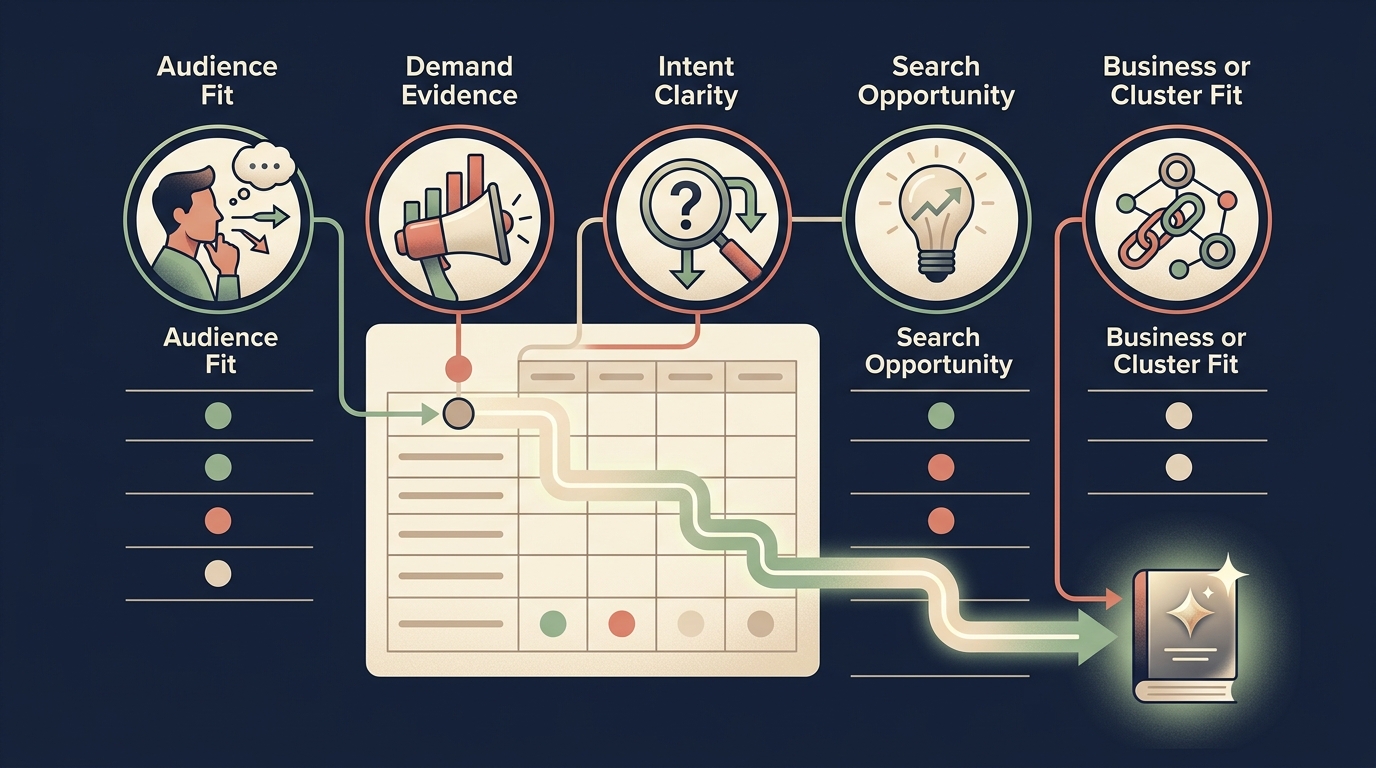
Use a lightweight scorecard so enthusiasm does not replace evidence. Score each factor from 0 to 2.
| Signal | 0 points | 1 point | 2 points |
|---|---|---|---|
| Audience fit | Weak connection to your audience | Related problem | Known customer or buyer problem |
| Demand evidence | Tool suggestion only | One credible signal | Multiple independent signals |
| Intent clarity | Ambiguous | Partly clear | Specific job or decision |
| Search opportunity | Strong, relevant results | Mixed results | Weak, generic, or outdated results |
| Business and cluster fit | Isolated topic | Supports an existing theme | Directly supports a useful cluster and offer |
This scorecard is an editorial decision tool, not an industry standard or ranking formula. Adapt the thresholds to your costs and publishing capacity.
A practical starting point is:
- 8 to 10: Create a focused asset if you can offer a complete answer.
- 5 to 7: Add a section to an existing page, publish a short video, or run a smaller test.
- 0 to 4: Keep it in the research backlog unless new evidence appears.
Give the demand evidence score real weight. A keyword mentioned in Search Console, customer conversations, and internal search is more compelling than one appearing in a single SEO tool.
Step 4: Choose the smallest useful format
A validated topic does not always need a standalone article.
Create a dedicated page when the query has a distinct intent, requires a substantial answer, and fits a broader content cluster. Update an existing article when the question is a natural subtopic. Use a short video when the answer is demonstrative, visual, or concise.
For example, “how to turn an FAQ into a short video” could support:
- A section within an article about AI video workflows.
- A short screen-recorded tutorial.
- A checklist distributed through social channels.
- A standalone guide only if the process needs enough detail to justify one.
Choosing the smallest useful format lowers the cost of being wrong. It also reduces the temptation to inflate a narrow question into a generic 2,000-word article.
Step 5: Define the test before publishing

Decide in advance what would count as encouraging evidence. This prevents continued investment in an unproductive topic simply because time has already been spent.
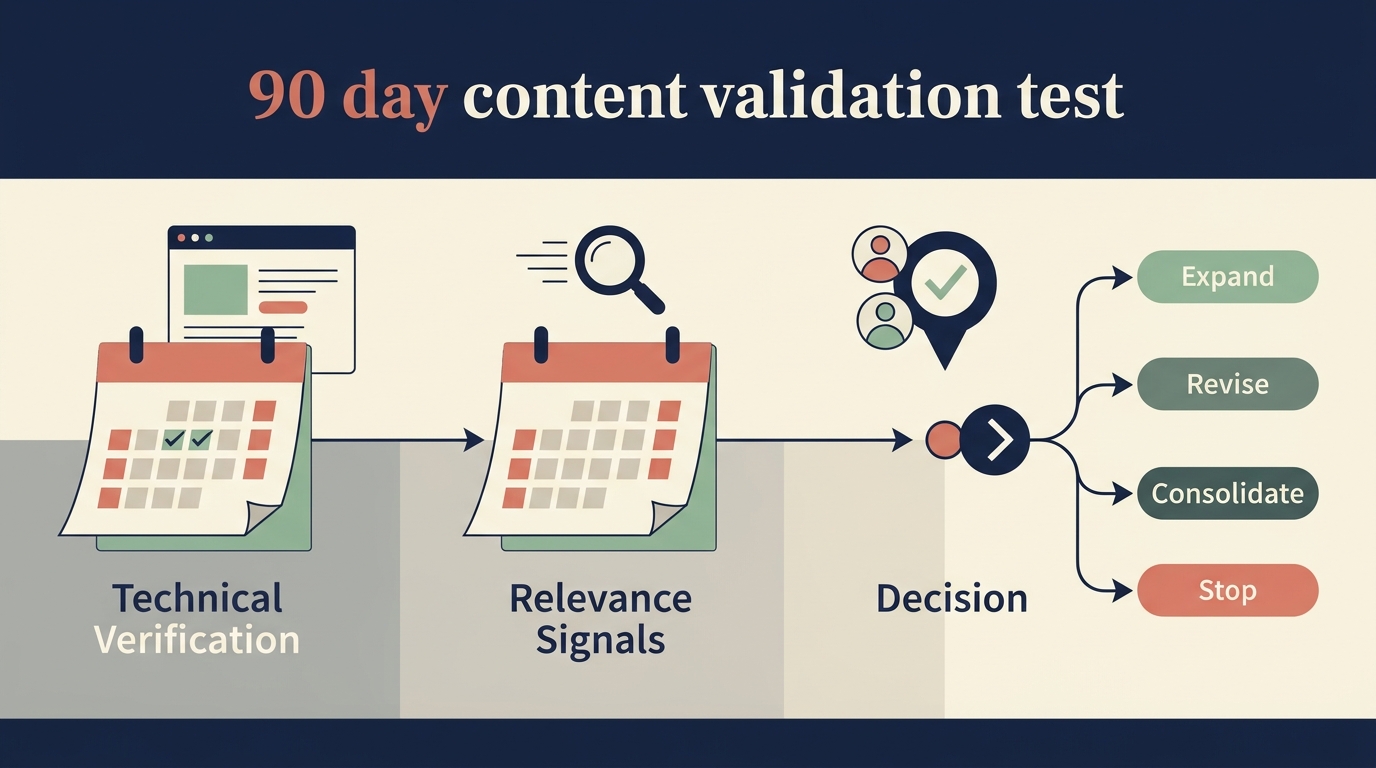
Use three review checkpoints.
Around day 30
Confirm that the page is indexable and check whether it has begun receiving impressions. Review the actual queries associated with the page, not only the exact target phrase.
No impressions may indicate a technical problem, limited demand, insufficient site authority, or a page that search engines do not consider relevant. It does not identify the cause on its own.
Around day 60
Look for broader signs of relevance:
- impressions across related queries
- clicks from qualified searches
- engaged visits
- video views or meaningful completion signals
- assisted actions such as downloads or product-page visits
Low absolute traffic can still be useful if the visitors closely match the problem your business solves. Impressions without useful engagement may point to an intent mismatch.
Around day 90
Make a decision:
- Expand: The topic attracts relevant queries or contributes to meaningful actions.
- Revise: The page earns impressions but receives few clicks, or visitors do not find the expected answer.
- Consolidate: The topic overlaps with another page and would be stronger as one resource.
- Stop: There is no meaningful evidence of demand and no strategic reason to keep investing.
Ninety days is not a universal SEO deadline. Newer sites, seasonal topics, and competitive markets may need longer. The checkpoint forces a decision rather than leaving every experiment open indefinitely.
A worked example for an AI content team
Suppose a keyword tool reports zero searches for:
social media scheduler with manual approval before posting
The team gathers the following evidence:
- Prospects have asked whether scheduled posts can be reviewed before publication.
- Similar wording appears in internal site searches.
- Search results include broad scheduler comparisons, but few directly explain approval controls.
- The topic fits existing content about responsible social media automation.
The score might look like this:
| Signal | Score | Reason |
|---|---|---|
| Audience fit | 2 | Relevant to lean marketing teams |
| Demand evidence | 2 | Appears in customer and site data |
| Intent clarity | 2 | The required workflow is explicit |
| Search opportunity | 1 | Relevant products rank, but explanations are broad |
| Cluster fit | 2 | Supports automation and workflow content |
| Total | 9 | Worth a focused test |
The team still should not assume the exact phrase will drive traffic. A useful article would answer the broader intent by explaining approval queues, role permissions, failure modes, and when manual review matters. The target phrase is the starting hypothesis, not the entire editorial brief.
Turn one validated topic into a controlled content workflow
Low-volume topics are easier to justify when one piece of research can support several useful assets. That does not mean publishing the same text everywhere.
A practical workflow is:
- Create an evidence-based brief around the validated intent.
- Draft the most complete version as an article or guide.
- Review facts, examples, product references, and brand language.
- Extract one narrow lesson for a short-form video.
- Adapt the idea into platform-specific social posts.
- Schedule distribution, while retaining human approval where appropriate.
- Record what generated qualified engagement and feed that information into the next topic decision.
For the approval-workflow example, the article might explain the decision criteria in depth. A short video could demonstrate a review checklist. A LinkedIn post could discuss the tradeoff between automation speed and editorial control. These assets serve the same intent without becoming duplicates.
MG Social Studio brings research, blog creation, short-form video, publishing workflows, and Growth Copilot recommendations into one workspace. That integrated approach can reduce handoffs between research, drafting, repurposing, and distribution. It does not replace validation, fact checking, or editorial judgment.
Start creating with MG Social Studio
Results vary. AI-generated recommendations and content should be reviewed before publishing.
What to measure when traffic is small
Pageviews alone are a poor decision metric for a low-volume strategy. Measure whether the content reached the right people and helped them take a relevant next step.
Useful signals include:
- Search impressions for the topic cluster
- Queries associated with the landing page
- Organic clicks and click-through rate
- Meaningful engagement with the article or video
- Visits to a relevant product or service page
- Newsletter signups, downloads, demo requests, or other defined actions
- Recurring customer questions that the content now answers
Keep discovery evidence separate from outcome evidence. A support question can indicate that a problem exists. It cannot establish that an article will rank, earn clicks, or generate customers.
Likewise, an impression shows that a page appeared in search results. It does not establish that the visit would have commercial value. Stronger validation combines several forms of evidence.
Common mistakes to avoid
Treating every zero as an opportunity
A database can generate thousands of obscure phrases. Most teams do not have enough editorial capacity to investigate all of them. Require evidence of audience fit before inspecting the rest.
Assuming the exact phrase is the market
The underlying problem matters more than exact wording. Build around an intent cluster rather than repeating one phrase throughout the page.
Publishing a new page for every variation
If several queries require the same answer, consolidate them. A strong page with useful sections is usually a better reader experience than a collection of nearly identical articles.
Skipping the live results page
A reported zero can still map to a competitive topic. Search the phrase, study the result types, and determine whether your proposed asset would add something concrete.
Automating before validating
AI can reduce the effort involved in drafting, video production, and distribution. It can also help a team produce irrelevant content faster. Validate the problem first, then use automation to execute a reviewed plan.
Waiting forever for conclusive data
Very narrow topics may never produce a statistically satisfying sample. Establish a decision window and use the best available combination of search, engagement, and customer evidence.
Frequently asked questions
Are zero search volume keywords worth targeting?
They can be when the underlying problem is relevant, the intent is clear, and independent evidence suggests real demand. A zero in a keyword tool is not enough reason to reject or approve a topic.
How can I validate a keyword with no volume data?
Check Search Console, customer questions, internal site searches, community discussions, autocomplete suggestions, and the live search results page. Look for agreement across more than one source.
Should every zero-volume keyword get its own article?
No. Many are better handled as sections within existing pages, FAQ entries, help documents, or short videos. Create a standalone article only when the query represents a distinct intent that needs a substantial answer.
How long should I test a low-volume keyword?
A 30, 60, and 90-day review cycle is a practical starting point. Adjust it for your site maturity, publishing cadence, seasonality, and market.
Can AI automate the process?
AI can assist with clustering, drafting, video adaptation, and distribution. Human review remains important for checking whether the topic is real, the evidence is sound, and the final content accurately reflects your product and audience.
Make zero a reason to investigate
A zero-volume label is most useful when it changes the question from “How many searches does this exact phrase have?” to “What evidence do we have that this problem matters?”
Start with customer language and first-party behavior. Check whether the live results leave room for a better answer. Then choose a format that is cheap enough to test and define the evidence that will guide the next decision.
For a lean team, this process keeps content work connected to real questions and measurable learning. It also leaves room for useful topics that conventional keyword estimates may not capture.
Sources
- SUSO Digital, Zero Search Volume Keywords: Hidden Gems or SEO Dead Ends?, analysis of zero-volume keywords, tool estimates, search intent, and competition.
- Cludo Help Center, Troubleshooting: no results or wrong results, guidance on reviewing ineffective internal searches and improving site search coverage.
- SEOmator, Zero Volume Keywords: 8-Step Validation Guide, guidance on treating zero-volume data as one signal and validating topics with Search Console, live results, customer language, and conversions.
- Google Search Central, A deep dive into Search Console performance data filtering and limits, documentation of anonymized queries, chart totals, and Search Console data limitations.
- Google Search Console Help, Performance report: Dimensions and data groupings, documentation of anonymized queries, data truncation, and query-table limitations.
- Google Search Central, Spam Policies for Google Web Search, guidance on scaled content abuse and the need for useful, original content.
- Google Analytics Help, Engagement rate and bounce rate, definitions for engaged sessions and engagement rate.
- Google Analytics Help, Automatically collected events, documentation for site-search, scroll, video, and engagement events in Google Analytics 4.
Sources
- https://susodigital.com/thoughts/zero-search-volume-keywords/
- https://help.cludo.com/faq/troubleshooting-no-results-or-wrong-results/
- https://seomator.com/blog/zero-volume-keywords
- https://developers.google.com/search/blog/2022/10/performance-data-deep-dive
- https://support.google.com/webmasters/answer/17011259
- https://developers.google.com/search/docs/essentials/spam-policies
- https://support.google.com/analytics/answer/12195621
- https://support.google.com/analytics/answer/9234069